Back
Research

Physical AI

Designing AI beyond screens. How embedding intelligence in physical systems can prevent human error in diagnostic healthcare.

Research · Healthcare Design·AI-Assisted Phlebotomy
Physical AI healthcare interaction design

The Challenge: Human Error in Phlebotomy

In diagnostic testing, sample collection is critical. A single error in this phase cascades through the entire lab process—false results, wasted samples, delayed diagnoses. Yet the current workflow relies entirely on human attention and memory.

The patient interaction is complex: confirmation, sample collection, labeling, storage. The phlebotomist juggles multiple information sources (test orders, patient data, vial requirements) while performing a delicate physical task. Errors happen not from incompetence, but from cognitive overload.

Diagnostic testing phases and error opportunities

Three phases of the diagnostic journey: pre-analytical (collection), analytical (testing), post-analytical (reporting). The pre-analytical phase is where most errors occur.

Current flow showing errors at each step

Phlebotomists and patients navigate a series of critical checkpoints. Each is an opportunity for error: wrong patient info (9%), order misinterpretation (1%), incorrect container (8%), labeling mismatches (9%), tube filling errors (13%), and storage failures (7%).

The insight: These aren't rare mistakes—they're endemic to the process. The phlebotomist is managing too much cognitive load while performing a precision task.

Why AI?

Do we really need AI? Yes. We leverage AI's capacity to store, process, and communicate massive information.

AI can't draw blood. It can't feel tissue or make judgment calls based on subtle physical feedback. But AI excels at what humans struggle with: tracking multiple variables simultaneously, remembering complex sequences, validating against large datasets, communicating information clearly.

In phlebotomy, that means: AI can confirm patient identity against records, validate that the selected vial matches the test order, verify that labels are correct before they're applied, and monitor the collection process to detect deviations.

Mapping AI to Error: Short-term vs. Long-term

AI capability mapping to errors - short term and long term vision

The same system serves two roles: short-term, it assists the phlebotomist (catching errors before they happen). Long-term, it becomes a performer (autonomous quality verification and execution).

Short-term: AI as Assistant

  • Confirmation phase: Compare label info & patient ID
  • Selection phase: Evaluate vial-label match, find correct filling status
  • Extraction phase: Monitor tube filling status, detect incorrect amount
  • Storage phase: Generate summary, identify storage location, notice unusual sample changes

Long-term: AI as Performer

  • Automation: Detect face ID, select correct vial, extract to right amount, store based on instruction
  • Integration: Act on human feedback, refine based on patterns
  • Reliability: Reduce human error to near-zero through consistent, tireless execution

The System: Hardware & Design

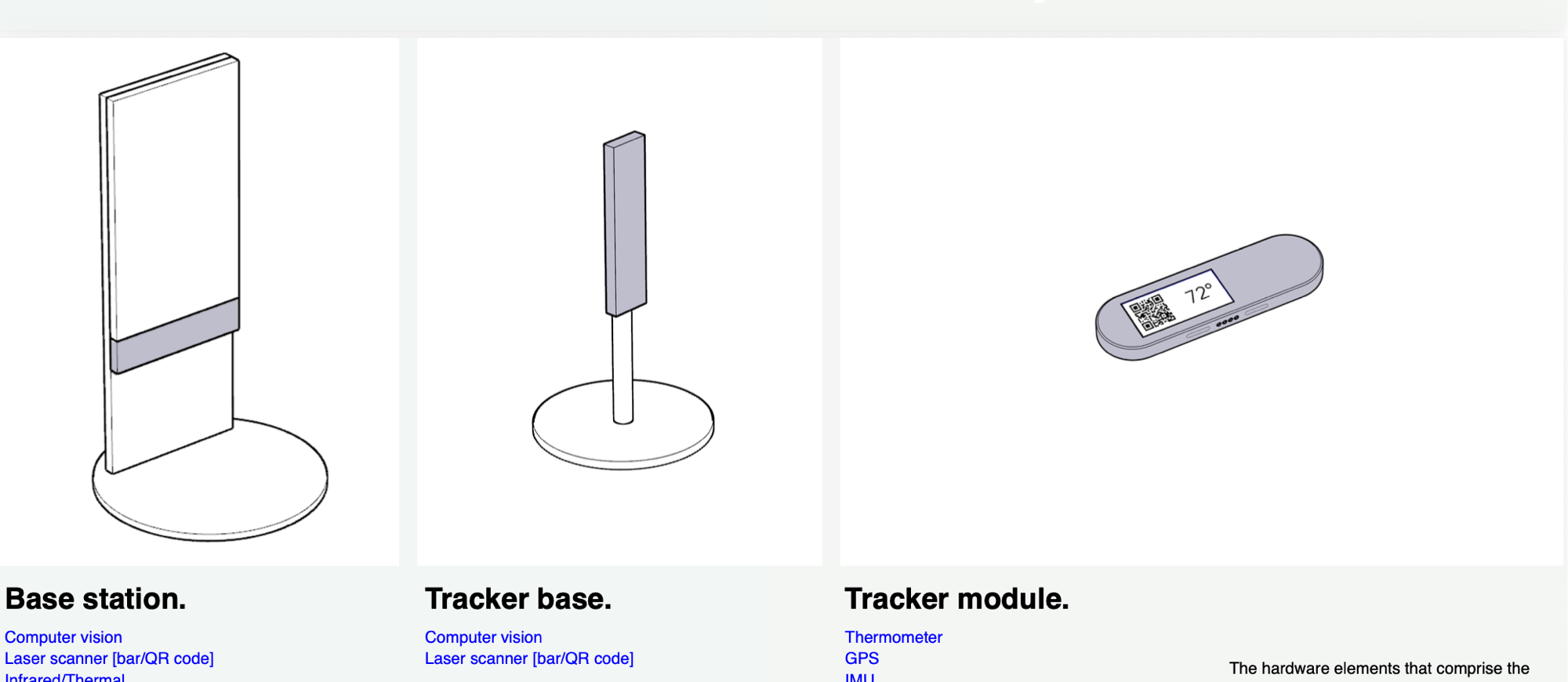
Hardware artifacts: base station, tracker base, and tracker module

Three physical components: The base station (computer vision, laser scanner, thermal monitoring, UI). The tracker base (sensing vial storage). The tracker module (thermometer, GPS, IMU for monitoring samples in transit).

The hardware elements are intentionally flexible and light-touch for users. The base station sits on a phlebotomist's desk. The tracker base monitors vial storage. The tracker module deploys into transport containers. All designed to be invisible to the user—present only when needed.

The User Flow: 8-Step Collection Journey

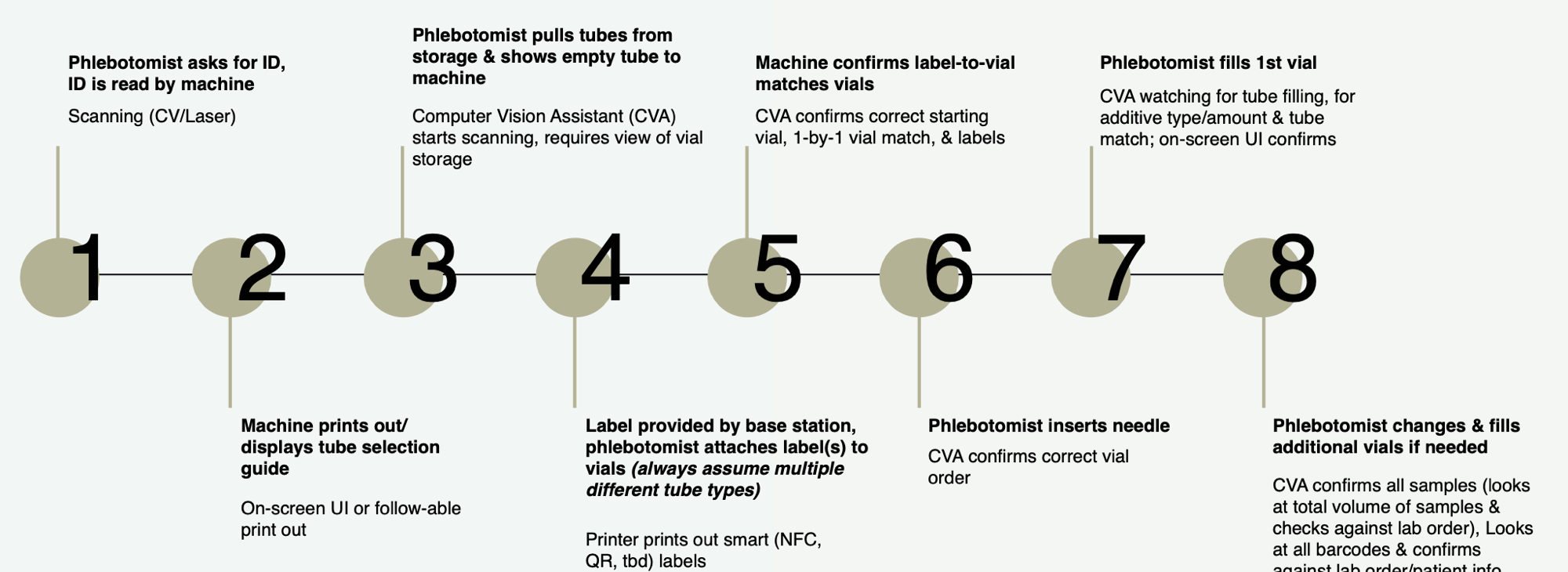
Proposed user flow with 8 interaction steps

Step-by-step, the system guides the phlebotomist through collection while validating each decision. Computer vision reads IDs. The CVA (Computer Vision Assistant) manages vial storage. On-screen UI confirms selections. Smart labels verify matches. The system is always watching, always confirming.

Step 1-2: Identity & Order

Phlebotomist asks for ID, ID is scanned. Machine prints tube selection guide. Phlebotomist confirms test order.

Step 3-4: Vial Selection & Labeling

CVA starts, requires view of vial storage. System confirms correct starting vial (1-by-1 match). Printer outputs smart labels (NFC, QR, barcode).

Step 5-6: Collection & Verification

Phlebotomist inserts needle. CVA confirms correct vial order. Phlebotomist fills first vial. CVA watching for tube filling, additive type/amount, tube match.

Step 7-8: Completion & Validation

Phlebotomist changes & fills additional vials if needed. CVA confirms all samples (total volume, all barcodes, against lab order). Labels confirm against patient info.

Final Design: The Patient Journey

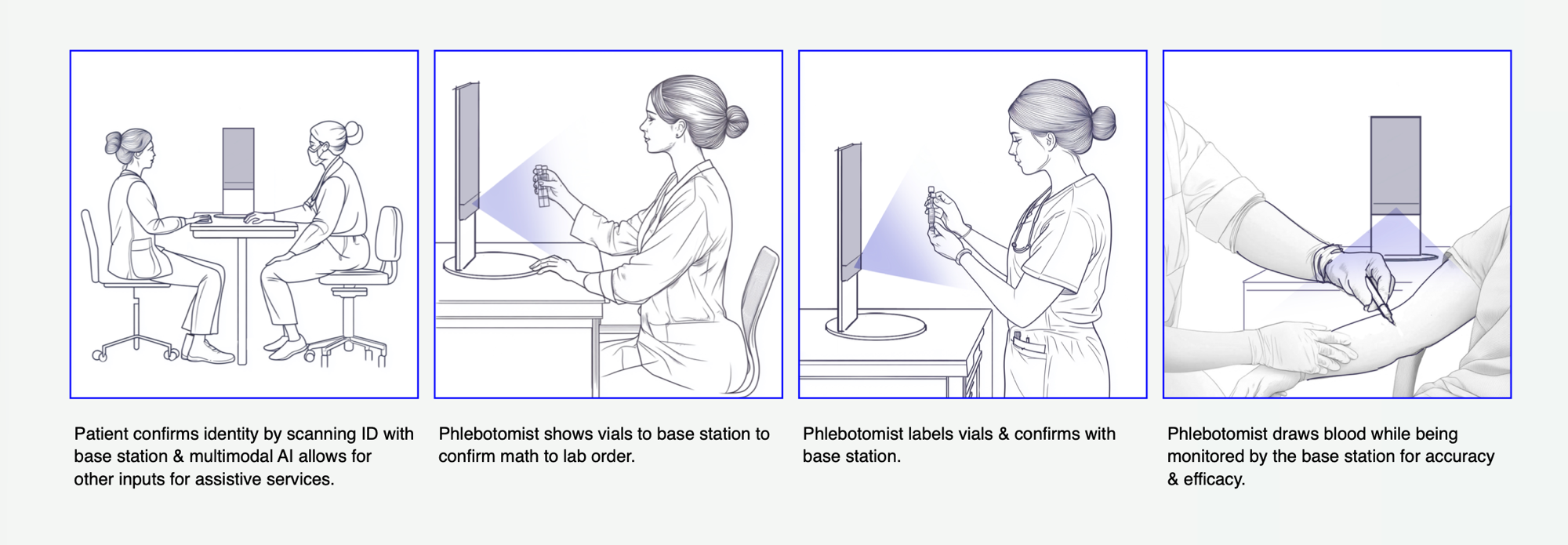
Final design showing potential sample collection journey

The redesigned interaction: Patient confirms identity using multimodal AI. Base station guides phlebotomist through collection. Labels and vials are verified in real-time. The entire journey is monitored, checked, and logged.

Team & Collaboration

Project team: Qiyu Hu, Greg McNamara, Emily Privot

This project was a collaboration between HCI research, industrial & UX design, and technology specialists—bringing together human-centered design with hardware and software engineering.

Key Takeaway

Physical AI isn't about replacing humans. It's about removing cognitive overload from moments that require precision. The phlebotomist's skill—understanding tissue, sensing pressure, making judgment calls—remains irreplaceable. But the burden of remembering 10 variables while drawing blood? That's where AI excels.

When AI is embedded in the physical environment, it becomes a tool that feels natural, not intrusive. It doesn't ask for input; it confirms choices. It doesn't replace the human; it amplifies their focus.

Related experiences
  • CMF & Technology Design — Industrial Design, AI Integration
  • Healthcare Systems — Error Prevention, Workflow Optimization
  • Human-AI Collaboration — Assistive Design Patterns