A collection of reimagining the chatbot
Exploring how prompts reshape design workflows—generative design meets human intent.
The interaction between humans and AI is fundamentally changing how we design. When a prompt becomes the interface, the designer's role shifts from specifying every detail to orchestrating a conversation with a generative system.
The Promise
Imagine selecting a region on your canvas, describing what you want, and watching it fill intelligently. No need to manually create every element. No need to spend hours on execution. Just intent, articulated clearly.
This is the dream of generative design workflows. But getting there requires rethinking fundamentals:
Task Analysis: What "Asking a Question" Takes
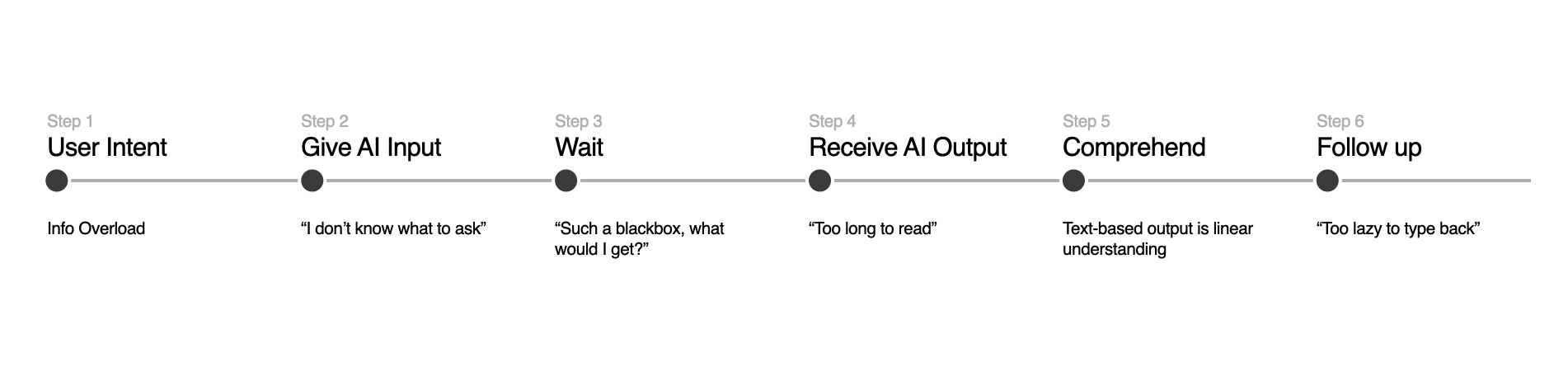
A user's interaction with a chatbot involves six distinct steps—each with its own friction points and assumptions.
Prototypes Exploring These Dimensions
Select & Fill with Prompts awareness
The core interaction model: select a region, describe what you want, and let the AI fill it in. This prototype tests whether prompting can become a natural design tool, bridging intent and execution.
I Am Always Here—Just Let Me Know browsing & awareness combined
What if the AI didn't wait to be asked? This prototype reimagines the assistant as proactive and present, reducing the cognitive load of "knowing what to ask." It explores the assumption that users must always initiate.
AI–AI Interaction comprehend
When two AI agents communicate, what happens? This prototype visualizes real-time conversation between systems, exploring how they resolve misunderstandings and align intent.
Knowledge Graph Visualization comprehend & followup
When AI generates an answer, where does it come from? This prototype visualizes the reasoning process—showing connections between concepts, sources, and inferences. Making the invisible thinking visible.
What Gets Tested
This collection explores prototypes across three dimensions of prototyping:
Implementation
Can a prompt engine understand spatial context? How does it preserve design intent through multiple iterations?
Look & Feel
How does real-time generation feel to use? Is the latency acceptable? Does the output feel like it was designed by a human or a machine?
Role
Does this make designers more productive or less? Does it amplify creativity or constrain it? How does human-AI collaboration change the definition of design skill?
The Challenge
The hardest part isn't building the system. It's understanding what designers actually want to communicate. The gap between intent and articulation is where most prototype attempts fail.
Getting the interaction model right means testing relentlessly. Testing what people ask for. Testing what the system misunderstands. Testing the moments where human and AI intent diverge.
Next Steps
This collection documents the journey. From first-pass concepts to polished interactions. From "does it work?" to "does it feel right?" to "does it matter?"
Each prototype is a question. Each iteration is an answer. And together, they're reshaping what the future of design tools could be.
- Generative design workflows
- Prompt engineering for spatial context
- Human-AI collaboration patterns
- Real-time generation feedback loops
- Designing for ambiguity and iteration