This collection was inspired by my work at Apple. While I can't directly show the work there because of NDA, I'm sharing some personal explorations around designing AI that meets users where they are.
Users often don't know what to ask an AI. Yet most AI products still wait inside a chat tab for the user to initiate. This collection explores different relationships between a person and an AI system.
Problem
The first step of thinking outside the box is to realize where the box is. There is a cool model called "task analysis" that helped me break out "mundane" interaction into detailed steps.
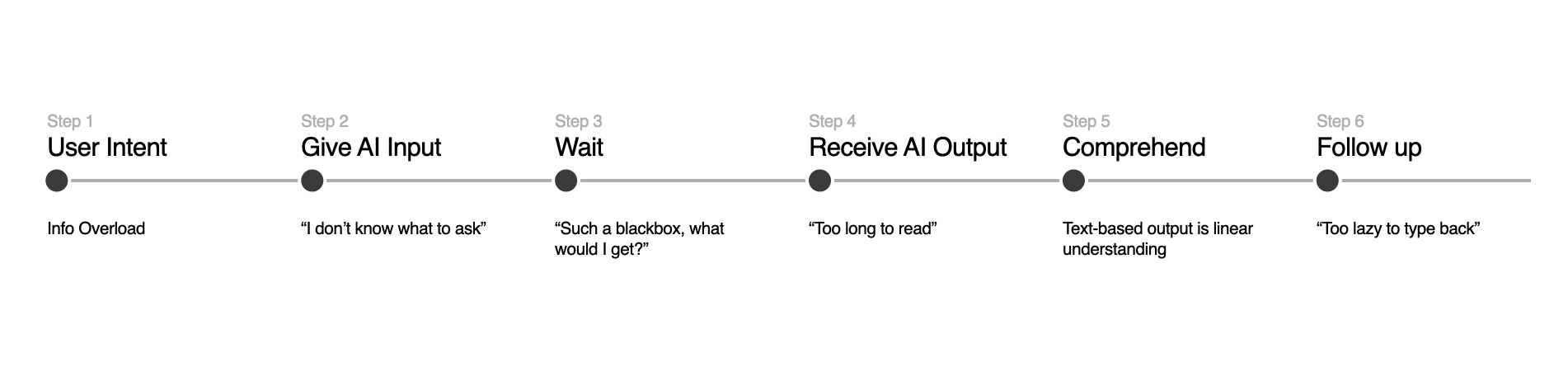
A user's interaction with a chatbot involves six distinct steps—each with its own friction points and assumptions.
I saw there are a lot of assumptions hidden in this flow:
- Awareness - User forms the awareness of what to ask - assumption: user knows clearly what to ask
- Expression - User the conversation by expressing the question - assumption: user express through typing (or clicking on the prompt buttons)
- Processing - User waits for AI to generate response - assumption: waiting is boring
- Reception - User realizes the AI finished process
- Interpretation - User understands AI response

Every step carries hidden assumptions about what users know, what the system can do, and how they work together.
Once I wrote those assumptions down, the design space became much bigger. Instead of asking "how do we redesign the chatbot?", I could ask: which part of this interaction flow doesn't have to exist at all?
Explorations
AI helps you form the question
awareness
Can AI reduce the work of prompt-writing without taking away your control?
So what's next after those concepts?
Prototypes, in my opinion, serve two goals:
- Produce knowledge or principles
- Be turned into production
Those goals need different next steps.
If the goal = production: run more controlled experiments
More business-related factors need to be considered.
For example, in scenarios where intrusiveness matters, we need to be careful about to what extent AI feels proactive versus intrusive in assisted browsing.
I created an interactive prototype with Claude Code and tested it using Wizard of Oz. A control panel let me adjust the metrics that defined when and how proactive the AI should be.
The implication was: don't go with proactivity for now. First, explore better ways to collect contextual data.
The interesting design problem became less about making AI proactively pop up, and more about what information it needs before that behavior feels justified.
If the goal = knowledge: look for reusable principles
There is one design-thinking model I really like: the analysis–synthesis model. It taught me not to just look at each concept individually, but to derive common themes across them—and then brainstorm again based on those themes.
Across these explorations, a few things kept coming back: make uncertainty visible, preserve user agency, design recovery as carefully as the happy path, and choose the interface based on the task instead of defaulting to chat.
Given those are the actual goals, the "chatbot" is probably just the current interface—one of many possible solutions.
More to come. And hopefully, as the technology changes, we get more room to imagine what those other solutions could be.